Spherical lens example
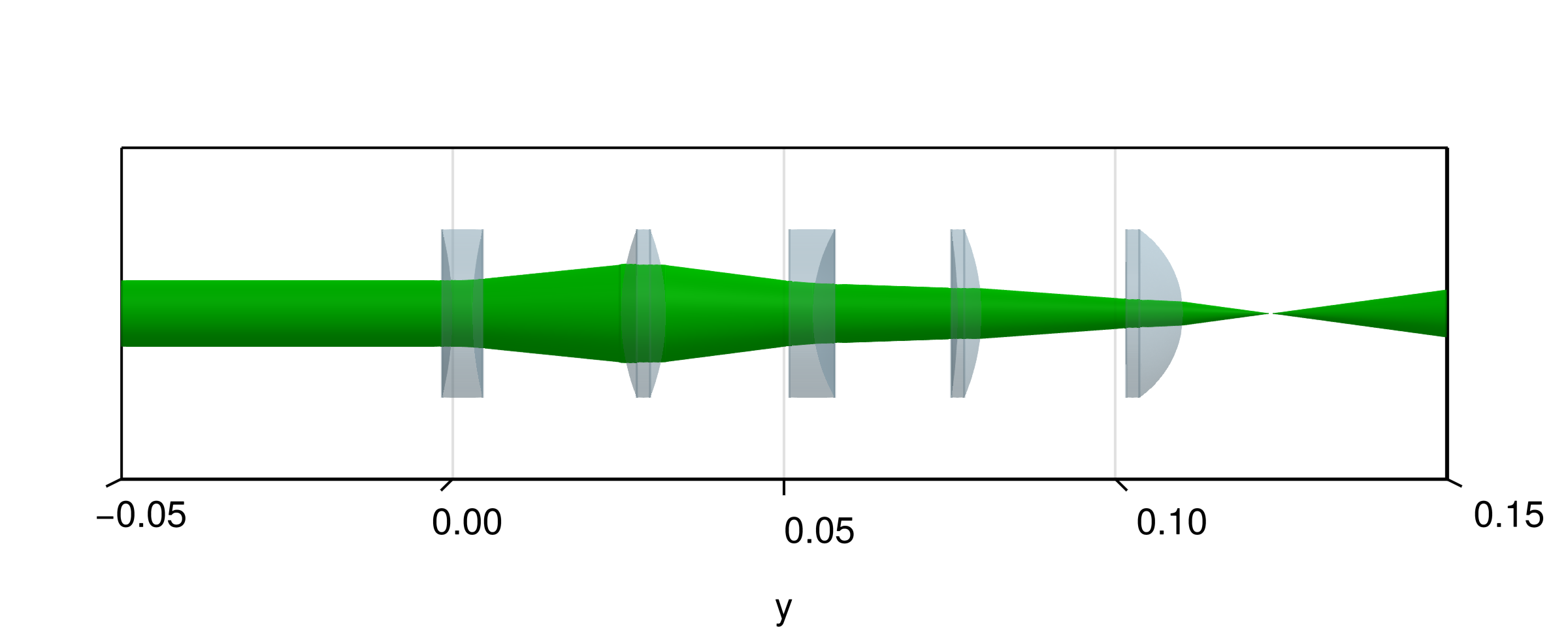
This example recreates the figure shown in the Spherical lenses section of the Lenses chapter. The lens parameters are taken from the Thorlabs website and are listed below:
First a function is defined that returns the refractive index
julia
using GLMakie, BeamletOptics

NBK7 = DiscreteRefractiveIndex([532e-9, 1064e-9], [1.5195, 1.5066])Then the different spherical lenses referred to above are generated using the SphericalLens convenience constructor.
julia
# lens diameter
d = BeamletOptics.inch

# lens types
r1 = 34.9e-3
r2 = -34.9e-3
l = 6.8e-3
LB1811 = SphericalLens(r1, r2, l, d, NBK7)

r1 = Inf
r2 = -15.5e-3
l = 8.6e-3
LA1805 = SphericalLens(r1, r2, l, d, NBK7)

r1 = -52e-3
r2 = 52e-3
l = 3e-3
LD1464 = SphericalLens(r1, r2, l, d, NBK7)

r1 = Inf
r2 = 25.7e-3
l = 3.5e-3
LC1715 = SphericalLens(r1, r2, l, d, NBK7)

r1 = -82.2e-3
r2 = -32.1e-3
l = 3.6e-3
LE1234 = SphericalLens(r1, r2, l, d, NBK7)The lenses are then moved into arbitray positions along the y-axis for the showcase. A GaussianBeamlet with
julia
translate3d!(LD1464, [0, 0*d, 0])
translate3d!(LB1811, [0, 1*d, 0])
translate3d!(LC1715, [0, 2*d, 0])
translate3d!(LE1234, [0, 3*d, 0])
translate3d!(LA1805, [0, 4*d, 0])

system = StaticSystem([
    LB1811,
    LA1805,
    LD1464,
    LC1715,
    LE1234
])

beam = GaussianBeamlet([0, -0.05, 0], [0, 1, 0], 532e-9, 5e-3)
solve_system!(system, beam)The following code will recreate the figure:
julia
fig = Figure(size=(600,240))
aspect = (1,4,1)
limits = (-0.025, 0.025, -0.05, 0.15, -0.025, 0.025)
ax = Axis3(fig[1,1], aspect=aspect, limits=limits, azimuth=0., elevation=1e-3)


hidexdecorations!(ax)
hidezdecorations!(ax)

render!(ax, beam, color=:green2)
render!(ax, system)